

Collective Predictive Coding and the Era of New Intelligence
A session report from JSAI 2026 on how collective intelligence, democracy, and science are challenged in the age of AI, organized by our Symbiotic Alignment team.
Session Report
Reconsidering Intelligence in the Age of AI
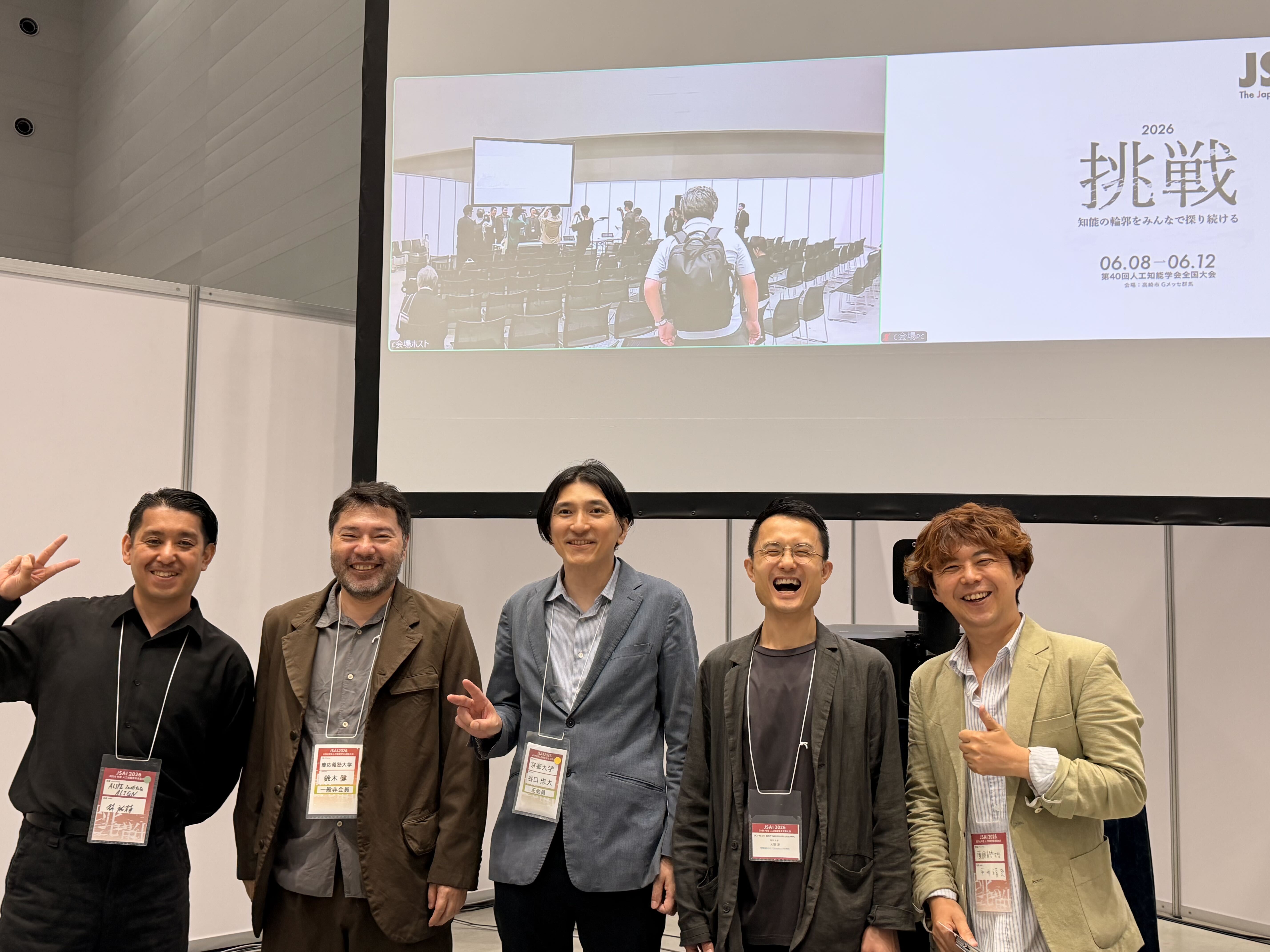
At The Japanese Society for Artificial Intelligence (JSAI) 2026, our Symbiotic Alignment research team organized a session titled Collective Predictive Coding (CPC) and the Era of New Intelligence.
The session emerged from three interconnected concerns. First, human history reveals a remarkable pattern: the recursive development of symbolic systems from language to writing, from economic institutions to scientific frameworks. Yet how these systems emerge from collective human activity remains inadequately understood. Second, the rapid integration of AI into society is creating tangible crises: democratic polarization, the automated production of scientific papers threatening the coherence of knowledge, and the gap between language models and embodied understanding. Third, the dominant view of intelligence as individual cognition misses what may be most essential: intelligence as fundamentally collective and multiscale.
The Theoretical Framework: Language as Shared World Model
To address these concerns, the session introduced Collective Predictive Coding (CPC) as a unifying theoretical framework. Rather than treating language as merely a communication tool, CPC proposes that language functions as a shared world model across society, integrating the internal representations of individual agents. This mathematical framework enables understanding not of isolated minds, but of the processes through which communities—whether scientific, political, or cultural—jointly create and evolve knowledge.
The hypothesis is both simple and profound: when humans communicate, they are not just exchanging information; they are dynamically coordinating their generative models of the world through symbols. This decentralized coordination enables language, shared meaning, and collective intelligence to emerge.
From Theory to Practice: Democracy and Shared Understanding
Yet theory alone cannot capture the full picture. Against the backdrop of global democratic regression and rising emotional polarization, Taiwan’s vTaiwan platform offers a concrete demonstration of how this theory translates into practice.
Using AI-enabled broad listening methods, vTaiwan discovered something unexpected in the same-sex marriage debate: both opposing sides shared common ground. But they had arrived at this common ground not through compromise, but through a reframing of language itself. Both sides spoke of “family,” but understood the term differently—one emphasizing partnership, the other kinship. By making these semantic differences visible, the platform allowed both communities to recognize they were not actually in complete disagreement; they were talking about different aspects of family relations.
In this process, humans and AI engaged together through dialogue to reframe the problem and co-create shared understanding. Rather than hierarchical control or one-sided imposition, this exemplifies the principle of Symbiotic Alignment (https://zenodo.org/records/20619149).
The Challenge Within Science Itself
Yet scientific progress reveals a different challenge. Most current AI systems excel at supporting “normal science”—improving efficiency within existing paradigms. But they face difficulties with genuine creativity and paradigm shifts. While AI can automate certain research steps and generate papers efficiently, the very efficiency creates a risk: science becomes optimized for error minimization at the cost of exploratory vision.
Moreover, the session drew on an insight from evolutionary biology: new ideas do not emerge from well-connected global communities, but from small, informationally isolated groups. Like genetic novelty arising through random drift in small populations, scientific novelty often arises through constrained communication within small intellectual communities. The implication is sobering: as AI connects everyone to everything, we may actually be losing the conditions necessary for genuine intellectual innovation. Paradoxically, the global tools designed to accelerate science may be destroying the local isolation that spawns paradigm shifts.
The Deeper Issue: Time and Stability
But there is an even deeper structural problem, one that emerges when we examine how intelligence actually operates across different timescales. Human cognition does not operate on a single timescale. It spans from bodily reflexes responding in milliseconds, to social interactions unfolding over minutes, to cultural norms and knowledge systems evolving across centuries.
Traditionally, these timescales have been separate—what physicists call an “adiabatic separation.” The stability of lower timescales (our immediate, embodied responses) provided a foundation upon which higher timescales (our cultural evolution) could operate. But AI technology is rapidly disrupting this separation. Digital systems operate at microsecond speeds, while cultural change historically needed centuries to stabilize. As AI becomes ubiquitous and omnipresent, the stable foundation is eroding. Cultural symbols no longer have time to settle before being challenged; individual reactions no longer have the constancy they once did.
This breakdown of temporal separation—this loss of adiabatic isolation—may be one of the most profound challenges we face. It is not a problem with AI itself, but with the temporal mismatch between the speeds at which different levels of human and social organization can safely change.
Toward an Integrated Understanding
Across these four domains—from theoretical foundations to democratic practice, from scientific challenge to temporal crisis—a pattern emerges. Each speaks to a different facet of a common problem: How do we construct and maintain collective intelligence in a world where the traditional separations and stabilities are breaking down?
CPC offers not a solution, but a framework for thinking about the problem differently. It suggests that intelligence is not something individual agents possess and then coordinate; it is something that emerges from coordination itself. It also suggests that preserving the conditions for collective intelligence in the AI age requires attending to multiple scales simultaneously—the local and the global, the stable and the changing, the individual and the collective.
The session did not pretend to solve these problems. Rather, it mapped the terrain of a challenge that will likely define the next era of research, policy, and social practice. In doing so, it pointed toward what may be most needed: the ongoing exploration of how diverse forms of intelligence can coexist, dialogue, and mutually transform as humans and AI genuinely co-evolve.